
Running Google Ads without the right strategy is one of the fastest ways to burn through a marketing budget. If you’ve searched for Google Ads help, you’re probably already feeling it — clicks that don’t convert, campaigns that drain money without clear results, or just the overwhelming complexity of the platform itself.
This guide breaks down what actually moves the needle in Google Ads, what most businesses get wrong, and how ViralWeb helps Atlanta businesses run campaigns that produce real revenue — not just traffic.
Why Most Google Ads Campaigns Underperform
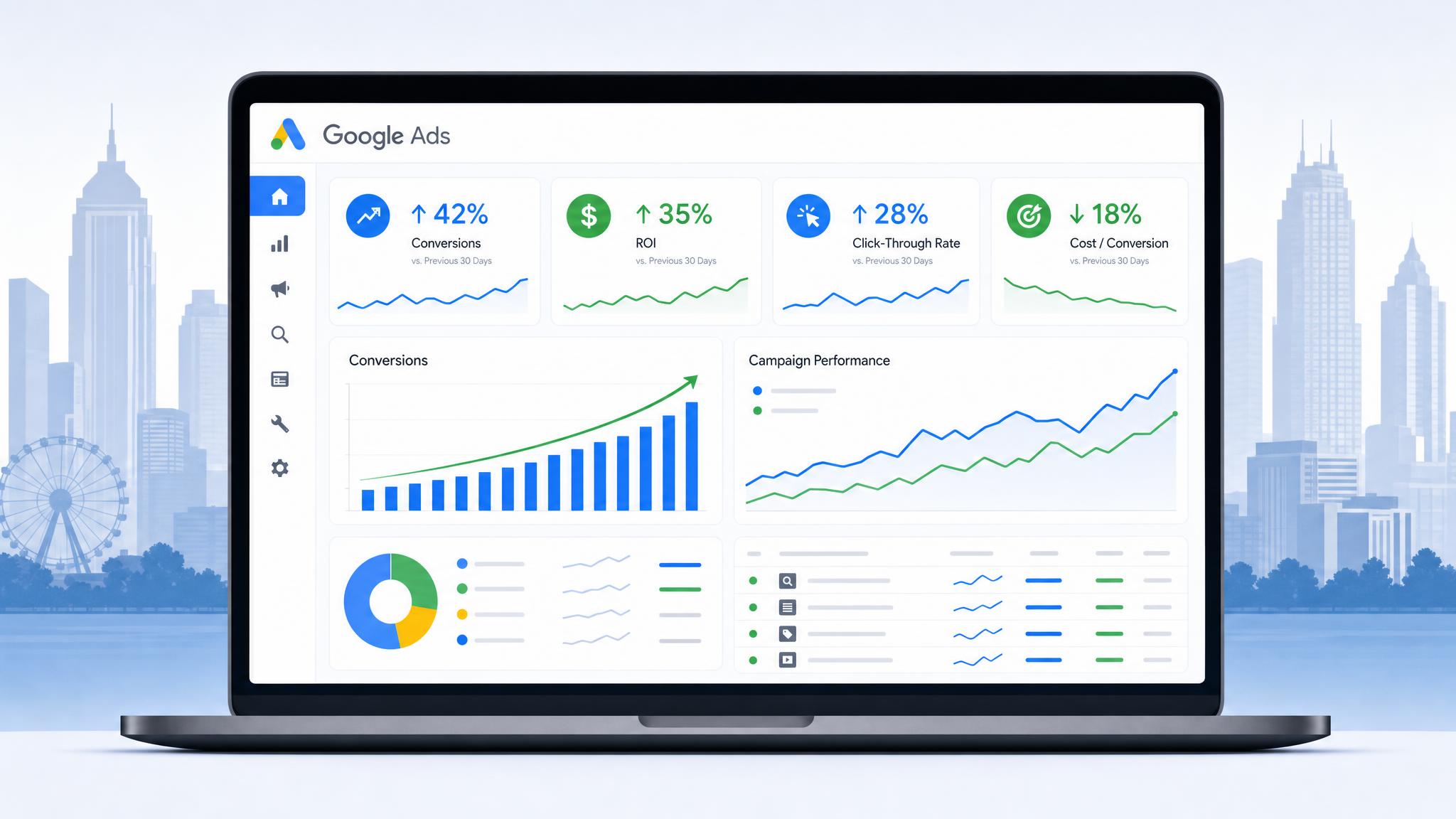
Google Ads can deliver an exceptional ROI — Google reports that businesses make an average of $2 in revenue for every $1 spent on Google Ads. But that average hides a wide range. Some businesses 5x their spend. Others lose money every month without realizing why.
The most common reasons campaigns underperform:
- Broad match keywords eating budget — targeting terms that are too vague attracts clicks from people who will never buy
- No negative keyword list — paying for searches that have nothing to do with your business
- Landing pages that don’t match the ad — a disconnect between what the ad promises and what the page delivers kills conversion rates
- Automated bidding without enough data — Smart Bidding needs conversion history to work; without it, Google guesses
- No conversion tracking — if you can’t measure what’s converting, you can’t improve it
Any one of these will quietly drain your budget. Most struggling campaigns have two or three.
Google Ads Help: Building a Keyword Strategy That Actually Works
Google Ads help starts with keyword selection — and most businesses default to broad match keywords because they seem to capture more traffic. They do. But broad match also means your ad shows for searches you’d never approve manually.
A smarter approach:
- Start with exact and phrase match to control which searches trigger your ads
- Build a negative keyword list from day one — add irrelevant terms before you waste spend on them
- Organize campaigns by intent — someone searching “how much does Google Ads cost” is at a different stage than someone searching “Google Ads agency Atlanta”
- Use long-tail keywords for lower competition and higher intent (e.g., “Google Ads management for small business Atlanta” converts better than “Google Ads help”)
Keyword strategy isn’t a one-time setup. It’s something you review weekly, especially in the first 30-60 days of a campaign.
Landing Pages: Where Most Campaigns Actually Break
You can have a perfectly optimized campaign and still lose money if your landing page doesn’t convert. This is where businesses often stop looking when results disappoint — they assume the problem is the ads.
A high-converting landing page for a Google Ads campaign needs:
- One clear offer — not your homepage with five different services
- Headline that matches the ad copy — message match reduces bounce rate immediately
- Social proof above the fold — reviews, case studies, or client logos
- A single, specific CTA — “Call now for a free audit” beats “Contact us”
- Fast load time — Google’s own data shows 53% of mobile visitors abandon a page that takes more than 3 seconds to load
If your ads are sending traffic to your homepage, that’s the first thing to fix.
Conversion Tracking: You Can’t Improve What You Don’t Measure
One of the most common gaps we see when auditing Google Ads accounts is broken or missing conversion tracking. Without it, you’re flying blind — you know how many clicks you got, but not how many became leads or customers. Getting real Google Ads help means having proper tracking in place before optimizing anything else.
Proper conversion tracking for a local service business typically includes:
- Form submissions — every lead form on your site
- Phone call clicks — both from the ad itself and from the website
- Booked appointments — if you use a scheduling tool
- Thank-you page views — as a fallback confirmation
Once tracking is in place, you can see your actual cost per lead, identify which campaigns and keywords drive conversions, and cut what isn’t working.
Smart Bidding: When It Helps and When It Hurts
Google pushes automated bidding hard — and it works, once a campaign has enough data. The threshold Google recommends is at least 30-50 conversions per month before switching to Target CPA or Target ROAS bidding strategies.
Before you have that data:
- Use Manual CPC or Maximize Clicks with a bid cap to control spend while building history
- Focus on getting clean conversion data first — even if it means slower scaling
- Don’t let Google auto-apply recommendations without reviewing them; some will increase spend without improving results
Once you have conversion history, automated bidding can significantly improve efficiency. The mistake is switching too early.
What ViralWeb Does Differently
Managing Google Ads well requires consistent attention — weekly search term reviews, bid adjustments, ad copy testing, landing page optimization. That’s the level of Google Ads help most business owners need but rarely get. Most generalist agencies don’t go deep enough.
ViralWeb is an Atlanta-based digital marketing agency that specializes in paid search for local businesses. When we take over a Google Ads account, we start with a full audit: keyword structure, match types, negative keywords, conversion tracking, Quality Scores, and landing page alignment.
From there, every campaign gets:
- Monthly strategy reviews tied to actual business goals — leads, calls, bookings
- Ad copy A/B testing to improve click-through rates over time
- Landing page recommendations (and builds, when needed)
- Transparent monthly reporting — your spend, your leads, your cost per acquisition
No black-box reporting. No automated emails with vanity metrics. Just clear data on what’s working and what we’re doing about what isn’t.
Ready to Get More From Your Google Ads Budget?
If your campaigns aren’t producing the results you expected — or you’re starting from scratch and want to do it right — see everything we offer or get in touch below.
Chat with a real member of our team right now via live chat at viralwebdigital.com. No bots, no wait, no sales pressure. Or call us directly at 770-714-5500.
