

Running Google Ads without professional help sounds simple enough: pick some keywords, set a budget, watch the leads roll in. Ask most small business owners how that story ends and you’ll hear the same thing: burned budget, low-quality clicks, and a campaign that never quite delivered.
That is exactly the problem PPC management services exist to solve. This guide explains what an agency actually does for your account each month, what the work typically costs, what results to expect in the first six months, and how to tell a good provider from a bad one before you sign anything.
What Are PPC Management Services?
PPC (pay-per-click) management is the ongoing work of building, running and improving paid search campaigns, most often in Google Ads. Instead of paying a freelancer or an agency to set up an account once and walk away, you pay for continuous optimization: choosing the searches worth bidding on, writing and testing ads, adjusting bids and budgets, tracking which clicks turn into calls and sales, and reporting on all of it in plain language.
The short version: you pay Google for the clicks, and you pay a PPC management company to make sure those clicks are worth paying for. If you want to see how this looks as a service offering, our Google Ads management team breaks down how we run accounts.
What PPC Management Services Include
A well-run service covers every layer of campaign performance, not just a weekly login. Here is what that looks like in practice.
Keyword Research and Match Type Strategy
Keyword research for PPC is different from SEO keyword research. You are not only looking for search volume. You are identifying which specific queries signal purchase intent, at what cost, and against what competition.
A PPC manager builds a keyword structure that includes:
- Core high-intent keywords (for example, “emergency plumber Atlanta”)
- Negative keyword lists that filter out irrelevant traffic
- A match type strategy (exact, phrase and broad match used on purpose, not by accident)
- Ongoing search term analysis to find new opportunities and cut waste
Ad Copy Creation and A/B Testing
Headlines need to match search intent, state the right differentiators, and include a call to action that feels urgent without being pushy. Description lines need to build trust and handle objections.
Good management means systematic testing: running two or more ad variations against each other, letting the data pick the winner, then iterating. Over months, small wins in click-through rate and conversion rate compound.
Bid Strategy and Budget Allocation
Google’s automated bidding (Target CPA, Maximize Conversions, Target ROAS) can work well, but only when conversion data is set up correctly, the campaign has enough history, and the targets are realistic. Out of the box, automated bidding often overspends or underdelivers.
A PPC manager sets bid strategies around your actual goals, adjusts them as data builds up, and moves budget toward the campaigns that produce results. They also manage dayparting (showing ads only during the hours that convert) and device bid adjustments, because mobile and desktop performance often differ sharply by industry.
Landing Page Optimization
Your ad earns the click. Your landing page closes the deal, or doesn’t. Many managers include landing page review and recommendations, because even a perfectly managed campaign fails when the page behind it doesn’t convert.
Key landing page factors that affect PPC performance:
- Message match between the ad headline and the page headline
- Fast load speed, especially on mobile
- A single, clear call to action instead of five competing options
- Trust signals such as reviews and certifications near the call to action
Google also scores the relevance of your ad, keywords and landing page together. Its own documentation on Quality Score for Search campaigns explains how expected click-through rate, ad relevance and landing page experience affect what you pay per click.
Conversion Tracking and Analytics
You cannot optimize what you don’t measure. Setting up conversion tracking for phone calls, form fills, purchases and chat starts is one of the highest-leverage things a PPC manager does. Google’s guide to setting up web conversions shows what that setup involves. Without it, you are optimizing for clicks instead of outcomes.
Beyond setup, a good Google Ads management service provides regular reporting that turns data into decisions: what is improving, what is being paused, what is being tested next, and what the numbers mean for your business goals.
How Much Do PPC Management Services Cost?
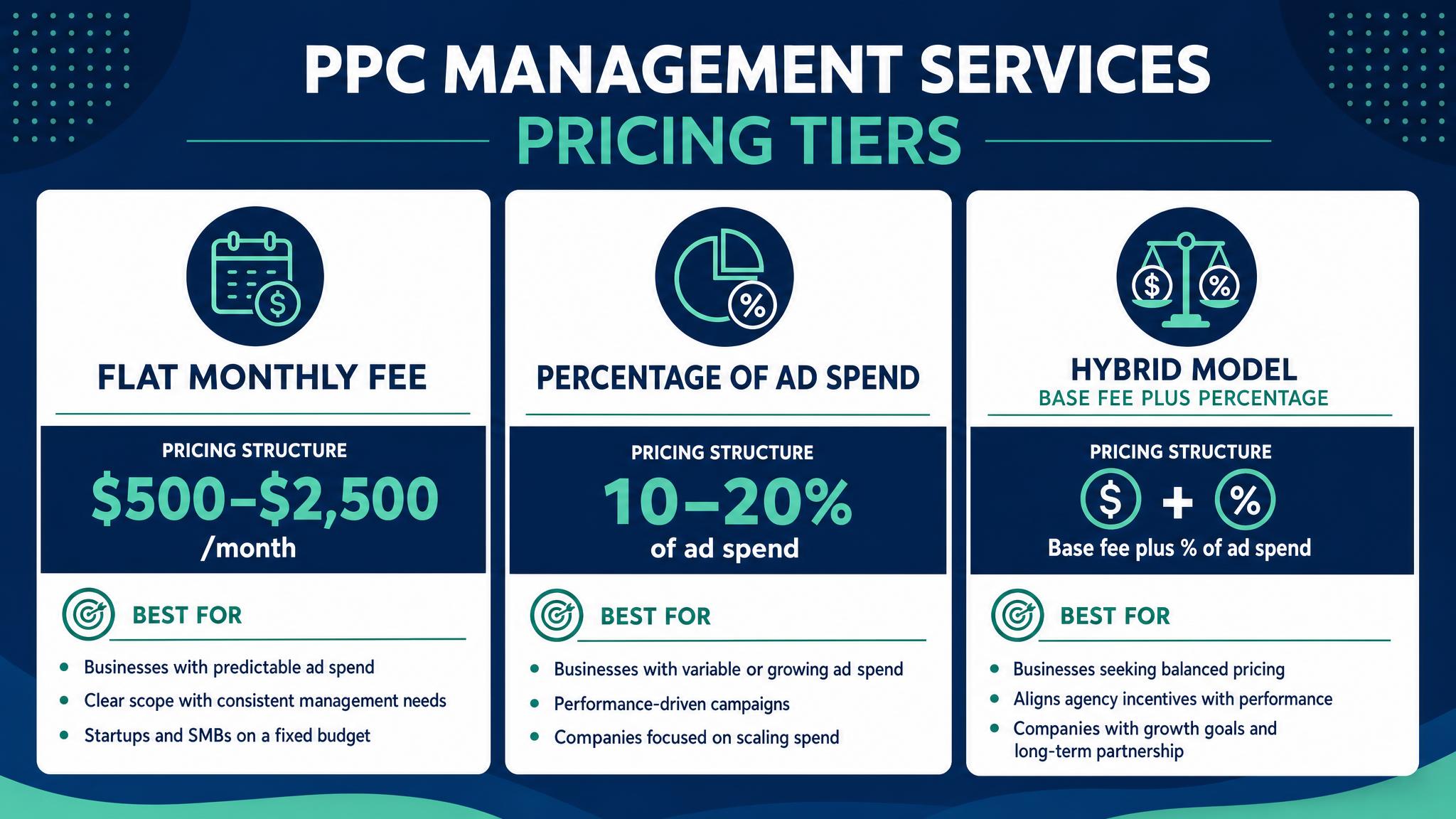
Pricing varies by agency model and scope. These are the most common structures:
- Flat monthly fee: typically $500 to $2,500 per month for smaller accounts, depending on campaign complexity and the number of platforms managed
- Percentage of ad spend: typically 10% to 20% of your monthly ad budget, more common at larger agencies
- Hybrid: a base fee plus a percentage, which ties the agency’s income to your budget as it grows
These are general market ranges, not a quote, and larger or multi-platform accounts cost more. Keep in mind that the management fee is separate from your ad spend, which goes straight to Google. For a closer look at that side of the budget, see our breakdown of what Google Ads itself costs.
The useful question is not “what is the cheapest fee?” but “what do I get back for it?” A management fee pays for itself when better targeting and tracking stop wasted clicks and lift your conversion rate on the same budget.
What to Expect From PPC Management Services: Timeline and ROI
Realistic expectations matter here. PPC is not instant, and any agency promising immediate results is overselling. A more honest timeline looks like this:
- Month 1: Account audit, campaign restructure, conversion tracking setup and the initial keyword structure. You may see some improvement, but this is mainly a foundation-building month.
- Months 2 to 3: Data accumulates. A/B tests produce early winners, negative keyword lists grow, and automated bidding starts to calibrate. Cost per lead typically begins to improve.
- Months 4 to 6: Gains compound. Campaigns optimized on several months of clean data usually outperform new or unmanaged accounts, and this is when the ROI case becomes clearest.
Every account is different, and results depend on your industry, competition, budget and website. What you should expect from any provider, regardless, is clear reporting on cost per lead or return on ad spend, not just clicks and impressions. The right partner will focus on conversion rate and cost per lead from day one. Cheap management that misses on conversions costs more in the long run than quality management that delivers measurable results.
Is Hiring PPC Management Services Better Than Managing Google Ads Yourself?
For most businesses with a meaningful budget, yes, because Google Ads rewards experience. Google makes it easy to launch a campaign and will even suggest keywords, budgets and ad copy, but those suggestions are built to increase ad spend, not to protect your return.
Common DIY pitfalls that drain budgets fast:
- Broad match keywords without negative keywords: you pay for searches that have nothing to do with your business
- No conversion tracking: you spend money with no idea what is driving results
- Weak Quality Scores: poor ad relevance means you pay more per click than a well-managed campaign for the same position
- Sending traffic to the homepage: instead of a dedicated landing page built to convert
- Set-it-and-forget-it bidding: automated strategies need proper setup and ongoing optimization
If your budget is small and you have the time to learn the platform, managing it yourself can be a fair starting point. Once monthly spend grows and every wasted click starts to hurt, professional management usually earns its fee. Our post on where Google Ads budgets get wasted goes deeper on the most common leaks.
How to Choose a PPC Management Company
Not all agencies are equal. Here is what to look for, and what should raise flags.
Green Flags
- They ask about your business goals before talking about keywords or budgets
- They set up conversion tracking before spending a dollar
- They provide transparent reporting with real data, not vanity metrics like impressions
- They explain their strategy in plain language
- They have case studies or references from businesses similar to yours
Red Flags
- Guaranteed results (“We’ll get you to #1 on Google!”). PPC doesn’t work that way.
- Long-term contracts with no performance accountability
- They own your Google Ads account instead of giving you access, so if they disappear, so does your data
- No mention of landing pages, conversion tracking or testing
- Monthly reports full of clicks and impressions but no cost-per-lead or ROAS data
Questions to Ask Before Hiring PPC Management Services
Before you commit to a provider, get clear answers to these four questions:
- Who will actually manage my account? Some agencies hand new clients to junior staff. Know who reviews your campaigns each week.
- How do you report on performance? Look for cost-per-lead and ROAS data, not just impressions and click counts.
- What happens to my account data if we part ways? You should own your Google Ads account and its history outright.
- What does your onboarding process look like? A solid engagement starts with a full audit, not immediate ad spend.
ViralWeb’s PPC Management Services Approach
At ViralWeb, we manage Google Ads campaigns for small and mid-size businesses that need results, not activity reports. Our approach is grounded in data and built around one metric: cost per acquired customer.
Every campaign we manage starts with a full account audit (or a clean build for new accounts), conversion tracking verification, and a keyword strategy tailored to your market. We test ad copy systematically, review search term reports weekly, and report on what matters to your bottom line.
We don’t lock you into long-term contracts, because we would rather earn your business month over month with results.
If you are running Google Ads now and aren’t confident in what you’re getting for your spend, call us at 770-714-5500. We’ll look at your account and give you an honest assessment, no pressure.