


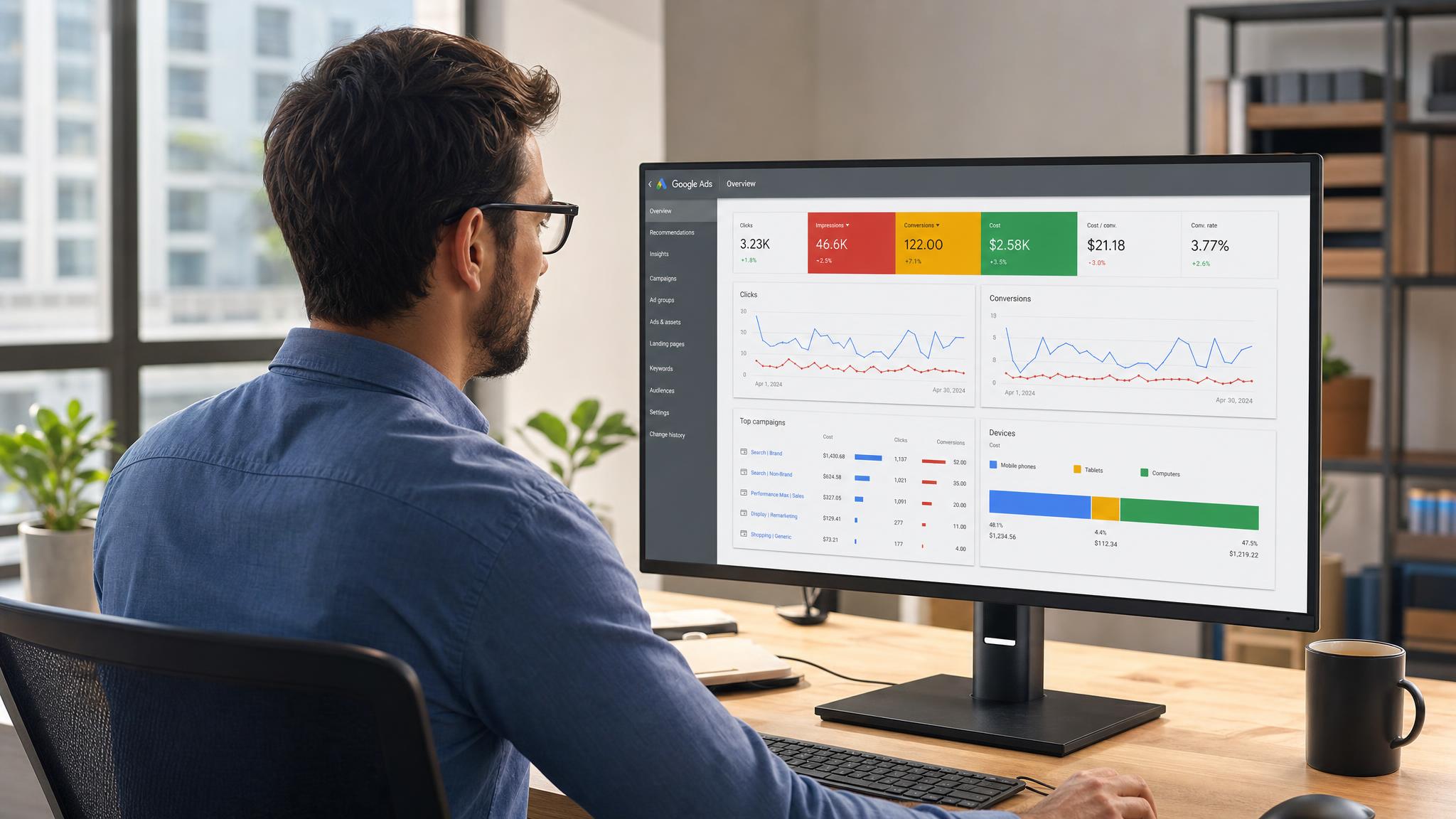
Running Google Ads without professional help sounds simple enough — pick some keywords, set a budget, watch the leads roll in. But ask most small business owners how that story ends, and you’ll hear the same thing: burned budget, low-quality clicks, and a campaign that never quite delivered.
The uncomfortable truth is that DIY PPC almost always costs more than hiring a professional. Not because the tools are bad, but because Google Ads rewards experience. Every day your bids are miscalibrated, your match types are too broad, or your landing page doesn’t match your ad copy, you’re paying for clicks that will never convert.
That’s exactly what PPC management services are designed to fix. This guide breaks down what professional PPC management actually involves, what it costs, and how to decide whether it’s the right move for your business.
Why DIY Google Ads Usually Costs More Than You Think
Google makes it genuinely easy to start an ad campaign. The platform will even suggest keywords, budgets, and ad copy — which sounds helpful until you realize those suggestions are optimized for Google’s revenue, not your ROI.
Common DIY pitfalls that drain budgets fast:
- Broad match keywords without negative keywords — you end up paying for searches that have nothing to do with your business
- No conversion tracking — you’re flying blind, spending money with no idea what’s actually driving results
- Weak Quality Scores — poor ad relevance means you pay more per click than a well-managed campaign for the same position
- Sending traffic to the homepage — instead of a dedicated landing page built to convert
- Set-it-and-forget-it bidding — automated strategies need proper setup and ongoing optimization to work correctly
A 2023 WordStream study found that the average Google Ads account wastes roughly 76% of its budget on poorly targeted clicks. For a business spending $2,000/month on ads, that’s $1,520 going nowhere. Professional PPC management typically costs far less than that waste.
What PPC Management Services Actually Include
When you hire a Google Ads management team, you’re not just paying someone to log into Google Ads once a week. A well-run service covers every layer of campaign performance. Here’s what that looks like in practice.
Keyword Research and Match Type Strategy
Keyword research for PPC is fundamentally different from SEO keyword research. You’re not just looking for search volume — you’re identifying which specific queries signal purchase intent, at what cost, with what competitive landscape.
A PPC manager builds a keyword architecture that includes:
- Core high-intent keywords (e.g., “emergency plumber Atlanta”)
- Negative keyword lists to filter out irrelevant traffic
- Match type strategy (exact, phrase, and broad match used intentionally, not randomly)
- Ongoing search term analysis to catch new opportunities and eliminate waste
Ad Copy Creation and A/B Testing
Writing ad copy that gets clicks — from the right people — is a skill. Headlines need to match search intent, surface the right differentiators, and include calls to action that feel urgent without being pushy. Description lines need to reinforce trust and handle objections.
Professional PPC management includes systematic A/B testing: running two or more ad variations against each other, letting data determine the winner, then iterating. Over time, this compounds. Campaigns that ran A/B tests consistently show 15–25% higher click-through rates within 60–90 days.
Bid Strategy and Budget Allocation
Google’s automated bidding (Target CPA, Maximize Conversions, Target ROAS) can be powerful — but only when conversion data is properly set up, the campaign has enough history, and the targets are calibrated correctly. Out of the box, automated bidding often overspends or underdelivers.
A PPC manager sets bid strategies based on your actual goals, adjusts them as data accumulates, and reallocates budget across campaigns based on which ones are producing results. They also manage dayparting (showing ads only during hours that convert) and device bid adjustments (mobile vs. desktop performance often varies dramatically by industry).
Landing Page Optimization
Your ad gets the click. Your landing page closes the deal — or doesn’t. Many PPC managers include landing page review and optimization recommendations as part of their service, because even a perfectly managed campaign fails if the page it sends traffic to doesn’t convert.
Key landing page factors that affect PPC performance:
- Message match between the ad headline and the page headline
- Load speed (each second of delay reduces conversions by ~7%)
- Single, clear call to action (not five competing options)
- Trust signals: reviews, certifications, case studies near the CTA
Conversion Tracking and Analytics
You cannot optimize what you don’t measure. Setting up proper conversion tracking — phone calls, form fills, purchases, chat initiations — is one of the highest-leverage things a PPC manager does. Without it, you’re optimizing for clicks, not outcomes.
Beyond setup, a good Google Ads management service provides regular reporting that translates data into decisions: what’s improving, what’s being paused, what’s being tested next, and what the numbers mean for your actual business goals.
How Much Do PPC Management Services Cost?
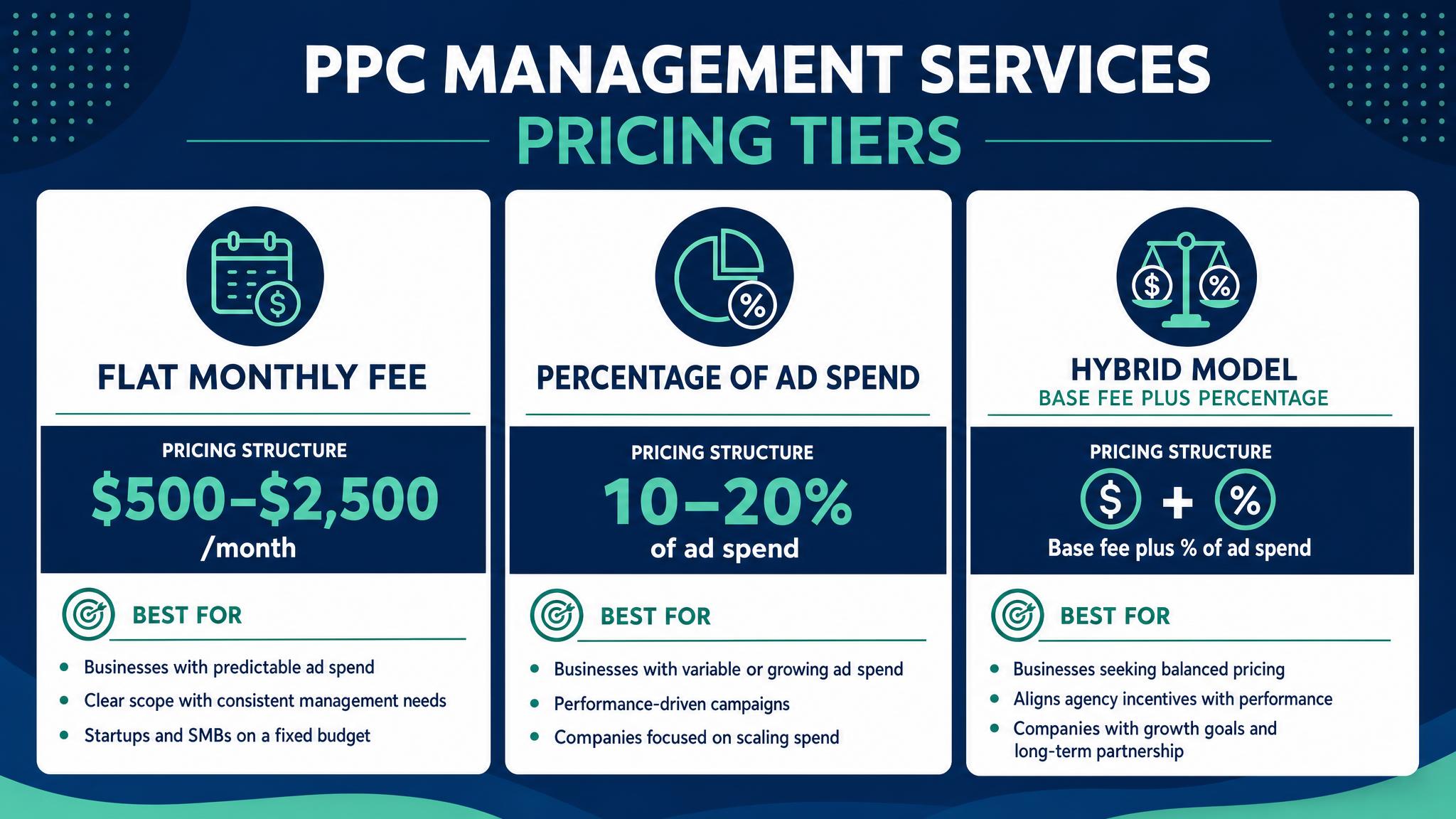
Pricing varies by agency model and scope, but here are the most common structures:
- Flat monthly fee: $500–$2,500/month depending on campaign complexity and number of platforms managed
- Percentage of ad spend: Typically 10–20% of your monthly ad budget (common at larger agencies)
- Hybrid: Base fee + percentage — gives agencies skin in the game as your budget scales
For a small business running $2,000–$5,000/month in ad spend, expect professional management to run $500–$1,200/month. Compare that to the average 76% waste rate in unmanaged accounts — the math usually favors professional management within the first 60 days.
What to Expect From ROI — And How Long It Takes
Realistic expectations matter here. PPC is not instant, and any agency promising immediate results is overselling. Here’s a more honest timeline:
- Month 1: Account audit, campaign restructure, conversion tracking setup, initial keyword architecture. You’ll likely see some improvement but this is primarily a foundation-building month.
- Month 2–3: Data accumulates. A/B tests produce early winners. Negative keyword lists grow. Automated bidding strategies start to calibrate properly. CPL (cost per lead) typically begins to improve.
- Month 4–6: Compounding gains. Campaigns optimized with 90+ days of clean data consistently outperform new or unmanaged accounts. This is when the ROI case becomes clearest.
Industry benchmarks (WordStream, 2024): average Google Ads conversion rate across industries is 4.40% for search. Well-managed campaigns in competitive niches often run 6–8%+. That difference in conversion rate — on the same ad spend — is the tangible value of professional PPC management.
These numbers also explain why evaluation criteria matter as much as budget. The right ppc management services provider will prioritize conversion rate and cost per lead from day one, not just click volume. Cheap management that misses on conversions costs more in the long run than quality management that delivers measurable ROI.
How to Evaluate a PPC Management Services Provider
Not all PPC agencies are equal. Here’s what to look for — and what should raise flags.
Green Flags
- They ask about your business goals before talking about keywords or budgets
- They set up conversion tracking before spending a dollar
- They provide transparent reporting with actual data (not vanity metrics like impressions)
- They can explain their strategy in plain language — no jargon smokescreens
- They have case studies or references from businesses similar to yours
Red Flags
- Guaranteed results (“We’ll get you to #1 on Google!”) — PPC doesn’t work that way
- Locked-in long-term contracts with no performance accountability
- They own your Google Ads account instead of giving you access — if they disappear, so does your data
- No mention of landing pages, conversion tracking, or testing — keyword-only agencies miss most of the picture
- Monthly reports full of clicks and impressions but no cost-per-lead or ROAS data
Questions to Ask Before Signing With Any PPC Management Services Team
Before you commit to a provider, get clear answers to these four questions:
- Who will actually manage my account? Some agencies hand new clients off to junior staff. Know who reviews your campaigns weekly.
- How do you report on performance? Look for cost-per-lead and ROAS data, not just impressions and click counts.
- What happens to my account data if we part ways? You should own your Google Ads account and historical data outright.
- What does your onboarding process look like? A solid ppc management services engagement starts with a full audit, not immediate ad spend.
ViralWeb’s PPC Management Services Approach
At ViralWeb, we manage Google Ads campaigns for small and mid-size businesses who need results, not activity reports. Our approach is grounded in data and built around one metric: cost per acquired customer.
Every campaign we manage starts with a full account audit (or clean build for new accounts), conversion tracking verification, and a keyword strategy tailored to your specific market — not a template pulled from a competitor playbook. We test ad copy systematically, review search term reports weekly, and report on what actually matters to your bottom line.
We don’t lock you into long-term contracts because we’d rather earn your business month over month with results. That’s what effective PPC management services look like in practice.
If you’re currently running Google Ads and aren’t confident in what you’re getting for your spend — or want to understand what a well-managed Google Ads account actually looks like —, call us at 770-714-5500 — we’ll take a look at your account and give you an honest assessment, no pressure.