

If you’ve asked an SEO agency how long does SEO take to show results and gotten a vague answer like “it depends.” That’s technically true, but it’s not useful. You deserve a real answer with real numbers.
The honest answer: most businesses start seeing measurable SEO traction in 3 to 6 months, with meaningful organic growth arriving around 6 to 12 months. But those timelines shift significantly based on your site’s current state, your market’s competition level, and how aggressive your SEO strategy is.
Here’s exactly what drives that timeline, and what to watch for at each stage.
How Long Does SEO Take? The Short Answer
Google doesn’t rank new content overnight. It needs to crawl your pages, index them, assess their relevance and authority against competing pages, and then adjust rankings over time as it gathers click and engagement signals. That process takes time and it compounds.
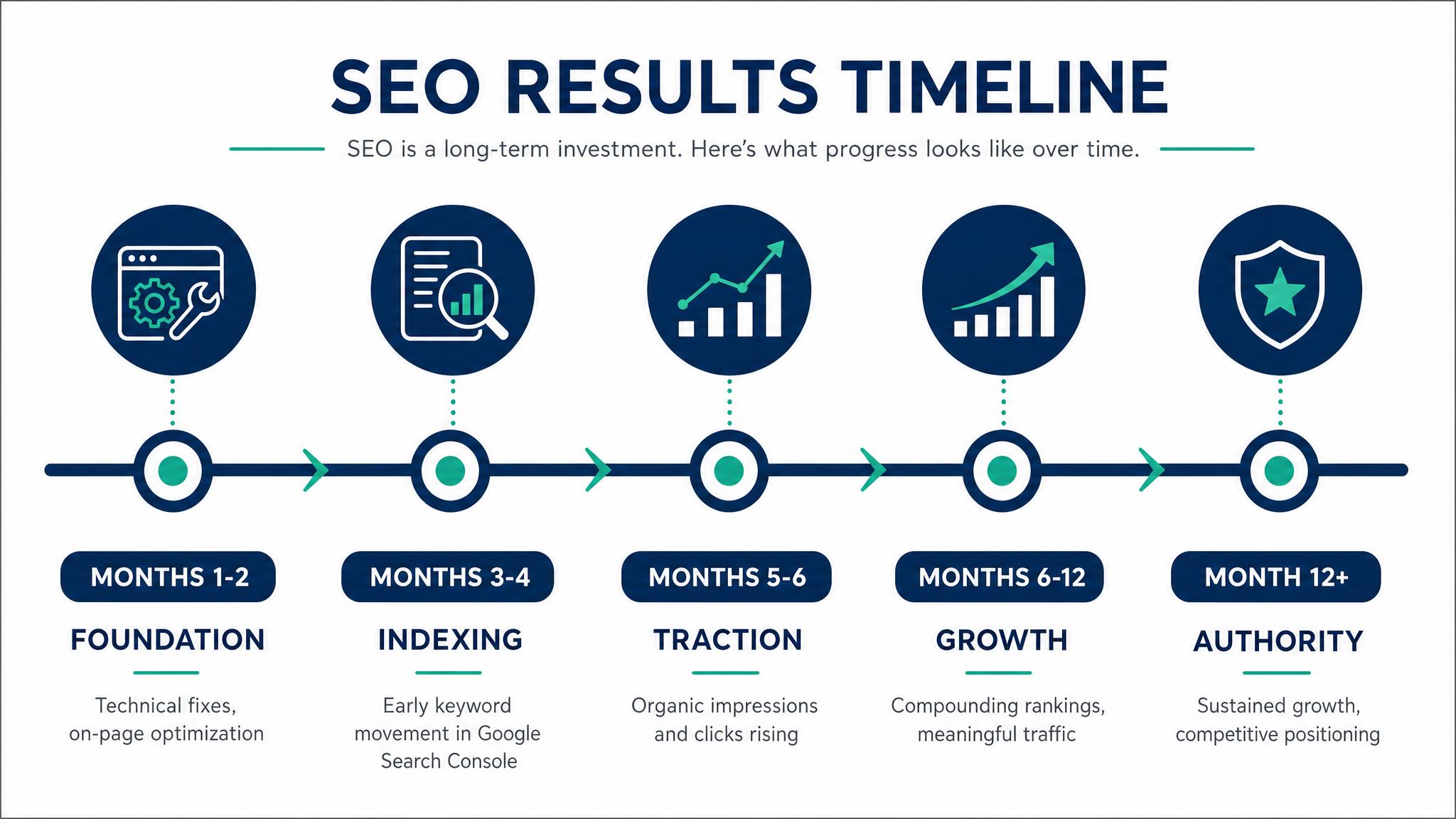
Here’s a realistic SEO results timeline for most small-to-midsize businesses:
- Months 1 to 2: Foundation work (technical fixes, on-page optimization, initial content). Little to no visible ranking movement yet.
- Months 3 to 4: Google begins indexing new content. Early keyword movement starts showing in Google Search Console. Some low-competition terms may reach page 2 or 3.
- Months 5 to 6: Traction becomes measurable. Organic impressions and clicks start rising. Pages targeting low-competition keywords may reach page 1.
- Months 6 to 12: Compounding growth. Well-optimized pages climb rankings as they earn backlinks and engagement signals. This is where meaningful traffic increases occur.
- Month 12 and beyond: Sustained growth and competitive positioning. Sites that have consistently produced content and earned links begin outranking longer-established competitors.
This is the realistic SEO time frame for businesses starting with a reasonably healthy site and a competent strategy. Lower starting points or more competitive markets push that timeline out.
What Affects How Long Does SEO Take to Work
The 6 to 12 month window is a solid baseline, but these variables can move you faster or slower.
Your Site’s Starting Point
A brand-new domain with zero content, no backlinks, and technical issues is starting from scratch. An established site with existing authority, decent technical health, and some existing rankings is starting on third base. All else equal, the established site will see faster incremental gains from SEO investment.
If your site has significant technical problems (slow load times, crawl errors, duplicate content, broken internal links), those need to be fixed first. Until Google can properly crawl and index your site, the content and keyword work on top of it won’t land.
How Competitive Your Keywords Are
This is the single biggest variable in how long does SEO take for any given business. Ranking for a local, niche service term might happen in 60 to 90 days with solid on-page work. Ranking for a broad national term could take years (if it’s achievable at all for a newer site.
Smart SEO strategy accounts for this by targeting a mix: go after low-competition, high-intent keywords early to build momentum and traffic, while building the authority needed to compete for higher-value terms over time.
Content Volume and Consistency
One blog post per quarter won’t move the needle. Google rewards sites that consistently publish useful, well-optimized content. Sites publishing several quality posts per week build topical authority faster than sites publishing sporadically.
Consistency also matters because it gives Google more to index and rank, creates more entry points for organic traffic, and signals that the site is actively maintained: all positive ranking factors.
Link Acquisition
Backlinks remain one of Google’s strongest ranking signals. A site earning quality links from authoritative sources will outrank a technically identical site with no links. Link acquisition takes time: it requires building relationships, creating link-worthy content, and running outreach campaigns. Sites with strong existing link profiles see faster gains; sites building from zero add months to meaningful results.
Search Intent Match
You can write a technically strong piece of content and still not rank if it doesn’t match what searchers actually want when they type that query. Google has gotten very good at understanding search intent: whether someone wants information, a specific page, or to make a purchase. Mismatching intent will suppress rankings regardless of how well-optimized the content is technically.
How Long Does SEO Take Compared to Paid Search?
Google Ads can put you at the top of search results quickly. SEO cannot. That’s a real tradeoff worth understanding clearly.
Paid search is a direct transaction: you pay for placement. SEO is an editorial system. Google decides where to rank you based on signals it has accumulated about your site’s relevance, authority, and trustworthiness over time. You can’t buy your way to the top organically; you have to earn it.
The flip side: once you’ve earned organic rankings, they don’t disappear when you stop paying. Organic traffic has a compounding, durable quality that paid traffic doesn’t. A business that has built strong SEO over 18 months has a real asset: one that keeps generating leads even when the marketing budget tightens. A business that has only run paid ads has no such asset.
Before committing to an SEO strategy, it’s worth understanding how much SEO costs so you can plan realistically for the full runway.
Red Flags: When Someone Promises How Long Does SEO Take to Work in 30 Days
A few things to watch for:
Page 1 in 30 days. For competitive terms, this is almost certainly a lie or involves tactics that will get your site penalized. For very low-competition, long-tail keywords on an established site, fast rankings are possible, but a legitimate provider will be specific about which keywords they’re targeting, not vague about guaranteed page-1 placement.
Rapid early rankings followed by a crash. If a provider gets you fast rankings through link spam, keyword stuffing, or other manipulative tactics, Google’s algorithms will eventually catch up. A penalty can erase months of progress and take significant work to recover from. Shortcuts that look like wins early on can become disasters later.
No explanation of the work being done. If your provider can’t tell you specifically what activities they’re doing each month and how those activities connect to ranking outcomes, that’s a problem regardless of the timeline they’re promising.
If you haven’t had a proper technical review yet, start with an SEO audit: it’s the foundation that makes the rest of this timeline work as described.
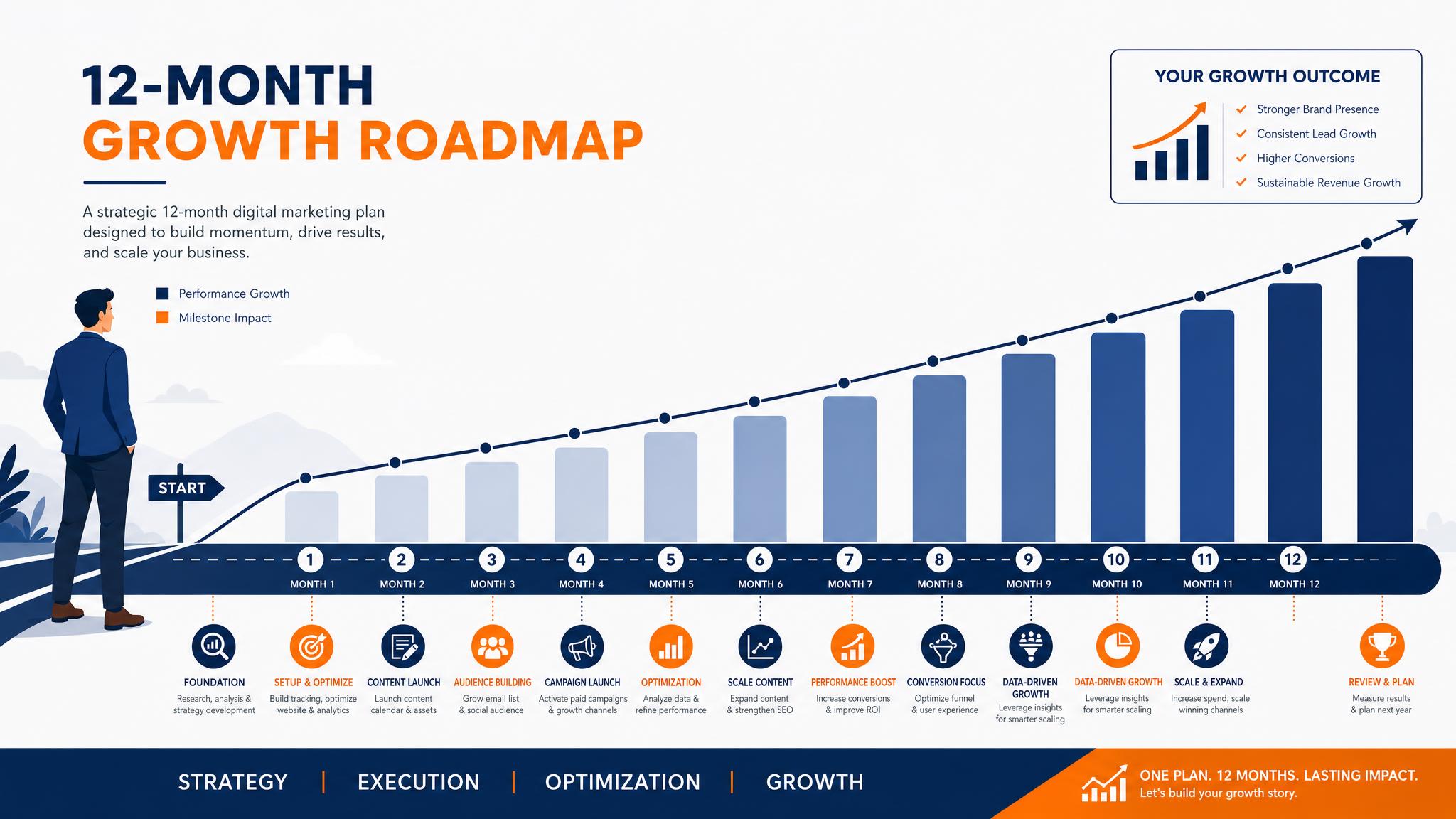
What to Expect Month-by-Month: How Long Does SEO Take With ViralWeb
Here’s how a typical ViralWeb SEO engagement actually progresses, stage by stage:
Month 1: Technical audit and fixes, keyword research and content strategy, on-page optimization of existing pages. You’ll get a baseline report showing where you’re starting from.
Months 2 to 3: Content production begins. New pages and blog posts go live. We start watching Google Search Console for indexing and early impression data.
Months 3 to 5: First ranking movements appear in GSC data. We identify which pieces are gaining traction and adjust the content strategy accordingly. Some clients see early traffic gains on low-competition terms.
Months 6 to 9: Measurable organic traffic growth for most clients. Leads and calls from organic search begin showing up. We’re also building links at this stage to accelerate movement on more competitive terms.
Months 9 to 12: Compounding returns. Clients who’ve been consistent with content and have clean technical health see meaningful organic traffic and lead volume. This is when the investment starts paying back clearly.
Is SEO Worth the Wait?
That depends on your business model and your customer value. Here’s a useful way to think about it:
If your average customer is worth a significant amount, and SEO eventually drives a consistent stream of new customers from organic traffic each month, you have a marketing asset that keeps paying even when ad budgets tighten. The 6 to 12 month runway to get there looks very different depending on whether you’re comparing it to a paid channel that requires ongoing spend to generate the same leads.
For most service businesses where customer lifetime value is high, SEO is one of the best long-term marketing investments available. For businesses with very low transaction values or extremely competitive national keywords, the math sometimes points elsewhere. ViralWeb will tell you honestly which situation you’re in.
Ready to map out a realistic timeline for your business? Call ViralWeb at 770-714-5500 or chat with a real human on our site (no forms, no automated responses).
The Bottom Line: How Long Does SEO Take to Work?
Here’s the direct answer:
- 3 to 6 months: Early traction, initial ranking movement, first organic traffic gains
- 6 to 12 months: Meaningful traffic growth, leads from organic, clear ROI starting to show
- 12 months and beyond: Compounding returns, strong competitive positioning, durable organic asset
These timelines assume consistent, quality work: real content, real technical fixes, real link acquisition. They also assume realistic keyword targeting matched to your site’s current authority level.
SEO takes time because earning Google’s trust takes time. But the businesses that commit to that timeline consistently come out with one of the most cost-effective lead channels available. If you want to talk through what’s realistic for your specific situation, ViralWeb is happy to have that conversation. Call 770-714-5500 or start a live chat on our site.